Meet Silke, Methods Engineer at BESIX Engineering. She joined the Meir project (Belgium) with no big expectations. Two years later, she has gained sharper technical instincts, a team she trusts, and a sense of pride every time she passes the site. This is a look inside Methods Engineering.
A complex renovation in the middle of Antwerp
The Meir smells faintly of fresh waffles. Shoppers move between storefronts, cyclists cut through the flow, and the street keeps its usual Antwerp rhythm.
But look up for a moment and you will see more than shop windows and brand logos. Historic façades tell the story of another era. On the corner of Jezusstraat, that story is being rewritten. On the former telecom site, a new campus for Karel de Grote University of Applied Sciences and Arts, among other facilities, is taking shape. What appears to passers-by as a lively destination is, behind the scenes, a remarkable engineering challenge.

The campus covers the equivalent of four football pitches, with 11,000 m² of retail space, all in a city centre that keeps moving around the works. Every choice matters: safety, sustainability and efficient use of materials have to be built into the method from the start. That is where Silke’s role becomes essential.
Methods Engineering: Figuring out how to build it
“Methods engineering is not something most people can imagine until they actually do it,” says Silke. “Your job is to figure out how something can be built, not just whether it can be built.” She translates the designs created by architects and engineering consultants into practical construction methodologies. Which crane should be used? Which materials? In what sequence should the works be carried out?
On renovation projects, sequencing is particularly critical. Think of structural columns that need to be removed while still playing a key role in the building’s stability. Or temporary steel structures that require space to be created within an already constrained environment. In practice, that means constantly switching between different perspectives.
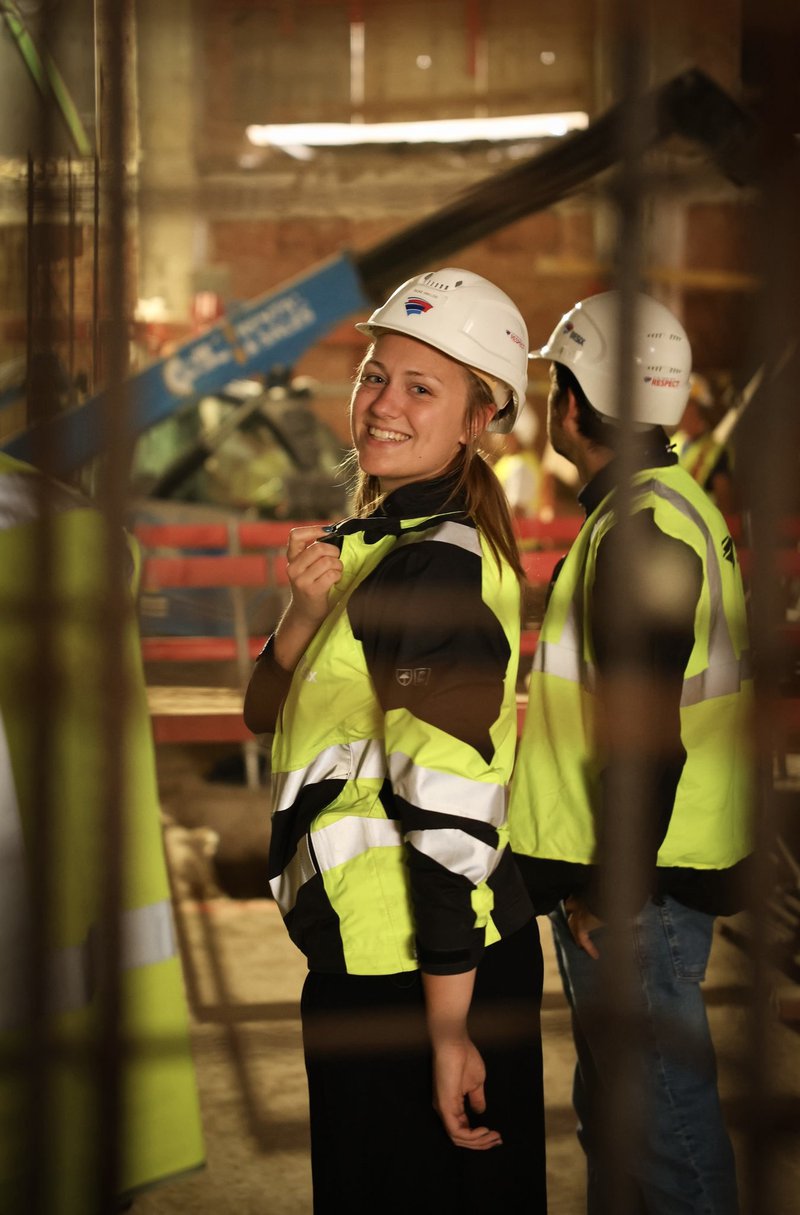
“I act as the link between the engineers in the office and the site team,” Silke explains. “What I enjoy most is being able to think outside the box with my engineering colleagues while also incorporating the practical insights of the people working on site.”
She prepares clear and accessible construction drawings, collaborates with BIM modellers to detect clashes, performs site inspections, and helps secure the required documentation and approvals. It is this combination of analytical thinking and practical execution that makes her role so unique.
When engineering plans become reality
The work is technical, exacting and, on a renovation project, rarely straightforward. The reward is seeing a solution move from calculation to concrete reality.

During the project, one important question emerged: how do you construct new floor slabs inside a building that must be preserved, where large cranes simply cannot be used?
“We initially considered hollow-core slabs and prefabricated concrete floor elements,” says Silke. “But because of the limited space, neither option was feasible. We had to think differently.”
The team ultimately chose a post-tensioned concrete slab that could be cast on site. “In reality, it was the only viable solution,” Silke explains. “The conditions were far from ideal.” Low outdoor temperatures affected the concrete pouring and curing process, putting pressure on the schedule from the start. That is where teamwork mattered most.
“You have to adapt, keep people aligned, communicate clearly on site and make decisions without losing momentum. That is what we did. These are the moments when everything clicks: the analysis, the site team’s input and the final solution.”
Why renovation got under my skin
“Before joining Project Meir, I never expected this world to captivate me so much,” Silke admits. Renovation is different from new-build construction.
“You work with what is already there: structures with their own history, oddities and surprises. Temporary stability becomes a puzzle you have to solve before anything else can move forward.”
That was the surprise: those puzzles became the part she enjoyed most.
Lessons from the Meir
After two years on the Meir project, Silke’s biggest takeaway goes beyond engineering. Working on a busy shopping street means every decision is visible. Deliveries, for example, must take place before 10 a.m. Lifting operations are carried out only centimetres away from trees and historic façades.
Alongside the technical challenges, communication and teamwork are just as important. “I learned how important it is to make references on drawings clearer and easier to read. What seems obvious on paper is not always obvious on site.”
Spending time on site changes your perspective. Do we have access? Where should demolition start? What is not shown on the drawings? Is everybody working safely? It is a constant interaction between planning and execution. When people listen, share what they know and back each other up, trust builds quickly. On a project like this, everyone really is working towards the same goal.

The team behind the project
What truly made this project special was not the technical challenge alone. “I had the opportunity to learn from the coolest colleagues,” Silke says with a smile. “And I use that word deliberately because it is true.”
Experience matters. But growth accelerates when colleagues are open, practical and generous with what they know. “When genuinely great people share their knowledge and are honest about the difficult parts of the job, you learn faster than you ever could through any training programme. I’m incredibly grateful for that.”

Seeing your work in the real world
Today, Meir feels different to Silke. “When I walk along the Meir now, I feel something. That building, that street, that renovation project: I helped make it happen. I know what is inside it in a way only the people who worked on it can understand. Once the building is fully completed, I hope to walk through its doors again.”
That is what construction gives you: proof of work done well, standing in the real world. Most people will simply walk past. That is fine. You know the story behind it.
On to the next challenge
Silke now takes that feeling with her into the next stage of her career. New projects await within BESIX Engineering. “No two problems are ever the same. That variety is what I was looking for when I started, and it is what lies ahead.”
“To the entire Meir team: thank you for the challenges, the patience and the incredible team spirit. And to anyone considering a career in Methods Engineering: get involved in a renovation project early. You will learn things there that you simply cannot learn anywhere else.”
Silke is a Methods Engineer at BESIX Engineering. After spending two years on Project Meir in Antwerp, she is now embarking on a new project within the department.
Want to work on complex renovation projects like Meir? Join BESIX Engineering and help build projects that test your thinking every day.